
MTo start a roofing company in Ireland, you need three things before you quote your first job: a registered business, the correct tax setup with Revenue, and the right insurance and safety cover for a construction trade. Get those sorted and the rest is tools, a van and a steady run of work.
Roofing has constant demand. Roofs fail, storms cause damage, and a large stock of older housing needs repair and replacement every year. The competition and the paperwork are real too, and being able to fit a slate roof does not mean you are set up to run a compliant business behind it.
This guide walks through the steps in the order they actually matter, from choosing a structure to landing your first customers, with the Irish rules that most generic guides get wrong.

What It Takes to Start a Roofing Company in Ireland
Before you register anything, get honest about four things: your trade experience, your startup funds, the services you will offer, and whether you will work alone or hire. Each one shapes the steps below, from your tax setup to your insurance.
- Trade experience. Years on the tools, ideally across repairs, re-roofs and different materials. Customers and main contractors both check this.
- Startup funds. Enough for a van, tools, insurance and the first few months before invoices clear.
- The services you will offer. Repairs and maintenance pay the bills early. Full re-roofs and flat roofing bring the bigger jobs later.
- Working alone or hiring. This changes your tax, insurance and safety obligations from day one.
Step 1: Write a Simple Business Plan and Decide Your Services
Start with a short, practical plan that sets out who you serve, what you offer and how you price it. A roofing business plan does not need to be long.
It needs to be honest about your local market, your real costs, and how many jobs a week you need to cover the van, the tools and your own wages.
Decide early whether you are chasing domestic repairs, full re-roofs, flat roofing and cladding, or commercial contracts. Each needs different skills, kit and marketing.
Most new roofers start with repairs and smaller re-roofs because the work comes in fast and the cash cycle is short, then move up to larger contracts as the reputation builds.
Step 2: Choose Your Structure and Register With the CRO
Decide whether to trade as a sole trader or a limited company, then register the business with the Companies Registration Office.
A sole trader is the fastest way to begin. You and the business are the same legal person, so setup is light, but you carry personal liability for every debt and claim. A limited company is a separate legal entity that caps your personal liability and reads as more credible to main contractors and commercial clients.
For a physical trade like roofing, where a fall or a water-damage claim can be serious, many owners choose a limited company for the protection. It costs more to run and brings annual returns to the CRO, so take an accountant’s view before you decide.
| Factor | Sole Trader | Limited Company |
| Setup | Fastest, least paperwork | More steps, incorporated through the CRO |
| Liability | Personal and unlimited | Limited to the company |
| Credibility with contractors | Lower | Higher |
| Admin and filing | Lighter | Annual returns, more accounting |
| Trading name | Register only if the name is not your own | Company name set on incorporation |
If you trade as a sole trader under any name other than your own, you must register that business name with the CRO within one month of adopting it, which costs around €20 online.
Step 3: Register for Tax With Revenue, Including RCT
Register for tax with Revenue as soon as you start trading. A sole trader registers for income tax through myAccount or ROS. A limited company registers for corporation tax. Both file and pay through Revenue’s Online Service.
The part most new roofers miss is Relevant Contracts Tax (RCT), a withholding tax on payments from a principal contractor to a subcontractor in construction. The rates are 0%, 20% or 35%.
If you take subcontract work for a main contractor, they deduct RCT from your payments at the rate Revenue sets for you, and a clean record is what earns the 0% rate. Revenue’s guidance on Relevant Contracts Tax sets out how deductions and credits work.
Two more tax points matter early:
- The moment you hire your own subcontractors, you become a principal and must operate RCT on what you pay them.
- You must register for VAT once turnover passes €85,000 for goods or €42,500 for services in any 12-month period. Most roofing work is then charged at the reduced 13.5% construction rate.
Step 4: Put the Right Insurance in Place
Get public liability insurance before you take on any work, and employers’ liability cover the moment you hire. Neither is compulsory by law in Ireland, unlike in the UK, but no main contractor will let you on site without both.
Public liability protects you if your work damages a customer’s property or injures someone, which on a roof is a real and expensive risk. Employers’ liability covers claims from your own staff if they are hurt at work.
Beyond those two, budget for cover on your tools and van, and check that the policy reflects working at height, since some insurers load or exclude it.
The CCPC’s public liability insurance market study found premiums climbing and cover harder to get in some sectors, so shop through a broker who knows the construction trade instead of taking the first quote. Keep the certificates handy, because main contractors ask for them before you set foot on site.
Step 5: Sort Your Safety Training and Construction Cards
Get your Safe Pass and construction skills cards in order before you or your crew step onto a site. The paperwork main contractors expect includes:
- Safe Pass, the safety awareness card required for anyone working on an Irish construction site. Most contractors will not let you on without a valid card.
- CSCS cards, under the Construction Skills Certification Scheme, for specific skilled work, for you and anyone you employ.
Working at height is the single biggest risk in roofing, and the Health and Safety Authority sets the rules you work to.
There is no separate roofer’s licence in Ireland, but that is changing. The Construction Industry Register Ireland (CIRI) is moving from a voluntary list to a statutory, mandatory register under the Regulation of Providers of Building Works Act 2022.
It is being phased in through 2026, starting with large residential developers, with trades like roofing in later phases. Getting familiar with the CIRI register and its requirements now means you are ready when your category goes live.
Step 6: Invest in the Right Tools, Van and Equipment
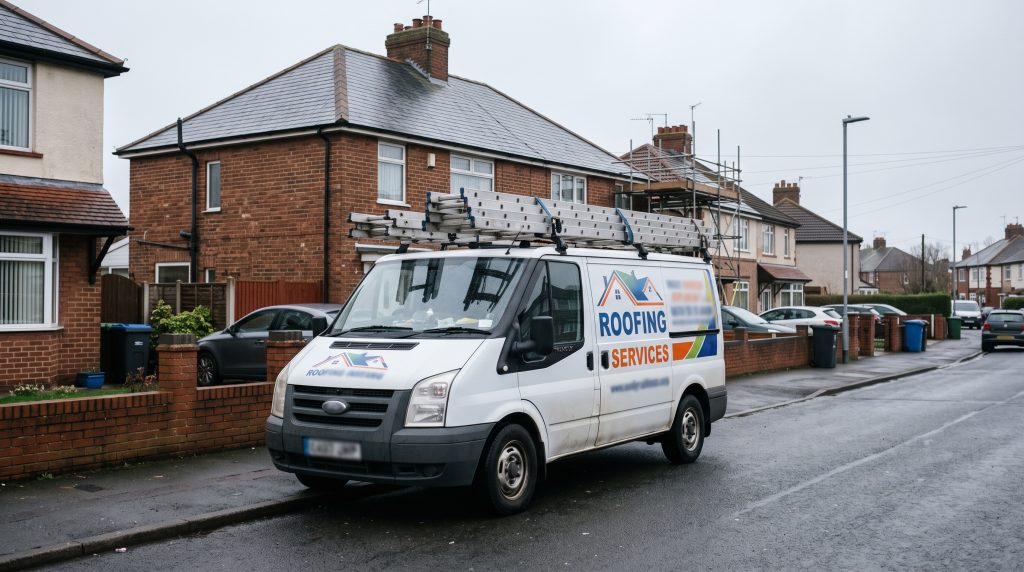
Kit the business out with a reliable van, quality roofing tools, access equipment and safety gear. The van is usually the single biggest startup cost, because it carries your materials, your ladders and your reputation.
After that comes access equipment like ladders, a tower or scaffolding, and the core hand and power tools for the materials you work with.
Do not cut corners on safety equipment. Harnesses, edge protection and proper access gear are both a legal expectation and the thing that keeps you working instead of recovering. Buy good tools once rather than cheap tools twice, and keep a float for the consumables every job burns through.

Step 7: Price Your Work and Quote Properly
Price every job on a clear, itemised quote that covers materials, labour, access, waste removal and your margin.
Underpricing is the fastest way to sink a new roofing business, because a job that goes wrong on a thin margin can wipe out the profit from three that went right. Work out your real day rate, including the van, insurance, tax and downtime, before you quote anything.
Give customers a written quote rather than a number over the phone. It protects you if the scope changes, and it signals that you run a proper business. Build in a contingency for the problems a roof always hides, like rotten timber or failed flashing you only find once the old covering is off.
Step 8: Market the Business and Win Your First Jobs
Get found by the people who need a roofer, then turn enquiries into booked work. Your first jobs usually come from word of mouth, local recommendations and a presence online. A simple professional website, an active Google Business Profile and genuine customer reviews do most of the heavy lifting for a local trade.
It also helps to understand what customers weigh up when they hire, so you can answer it before they ask. The same things that make a homeowner choose one roofer over another are the things to lead with in your marketing, like proof of past work, clear pricing, insurance and reliability.
Deliver well on the early jobs, ask every happy customer for a review, and the referrals start to compound.
Mistakes That Sink New Roofing Businesses
Most roofing companies that fail are let down by weak business habits rather than weak roofing. The trade skill is rarely the problem. The common ones to avoid:
- Underpricing to win work. It buys jobs you lose money on.
- Skipping insurance or buying too little. One claim can end the business.
- Ignoring RCT and tax deadlines. Penalties mount and a poor record pushes your RCT rate up.
- Taking on jobs beyond your crew or kit. A botched big job travels fast locally.
- No system for quotes and follow-up. Enquiries go cold while you are up on a roof.
Getting a roofing business off the ground is mostly admin you only have to do once. Register properly, get the tax and insurance right, and the trade side looks after itself.
The harder part comes later, when the first run of referrals dries up and the phone goes quiet. If you want a steady flow of enquiries instead of whatever word of mouth brings in, book a free marketing audit and we will show you where the work is going instead.